
If you’re researching weight loss options in New Zealand, you’ve probably come across both the HCG diet and keto. Both promise rapid fat loss. Both have passionate advocates. But they work in completely different ways — and for most people, one is clearly the better fit.
This guide cuts through the noise with an honest, NZ-specific comparison: how each diet works, what results you can realistically expect, the difficulty and lifestyle impact, cost in New Zealand dollars, and who each one actually suits.
How Each Diet Works
The HCG Diet
The HCG diet combines a low-calorie protocol (typically 500 calories per day) with amino acid drops taken three times daily. The drops — like HC-SLIM, which uses a proprietary amino acid formula — are designed to support fat mobilisation and suppress hunger during the calorie restriction phase.
The protocol runs for either 26 or 40 days, with two distinct phases: Phase 2 (the 500-calorie eating phase) and Phase 3 (a three-week maintenance phase where calories return to normal but starches and sugars are avoided). This stabilisation period is critical — it’s what locks in your results.
The Ketogenic Diet
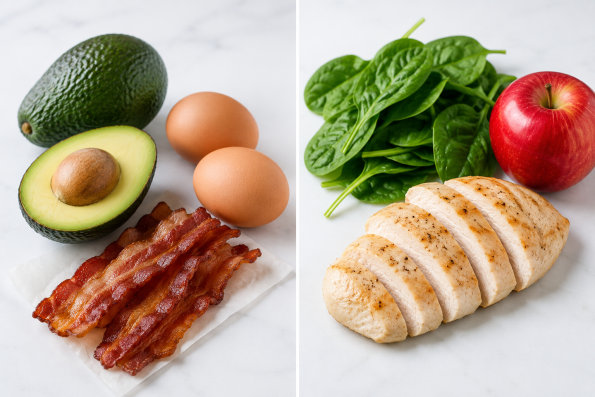
Keto is a high-fat, very low-carbohydrate diet that puts your body into ketosis — a metabolic state where it burns fat for fuel instead of glucose. There’s no set calorie limit; instead, you stay under around 20–50g of carbohydrates per day. Most keto dieters eat plenty of meat, eggs, cheese, avocado, nuts, and leafy greens.
Keto is an ongoing lifestyle change rather than a fixed program. There’s no endpoint — you either stay in ketosis or you don’t.
Speed of Results
HCG diet wins for short-term speed. Most people lose 0.3–0.5kg per day during Phase 2. On a 40-day program, typical results in NZ are 8–14kg of fat loss. This is fast — significantly faster than most keto dieters achieve.
Keto produces results, but more gradually. Most people lose 0.5–1kg per week once they’re fully in ketosis. That’s solid steady progress, but over 40 days you’re looking at 3–6kg — roughly half what the HCG diet delivers in the same timeframe.
It’s worth noting: early keto weight loss (week one) is largely water weight from glycogen depletion. The scale drops fast at first, then slows significantly. HCG diet fat loss is more consistent from start to finish.
Difficulty and Lifestyle Impact
HCG Diet: The 500-calorie restriction sounds extreme, but the HC-SLIM drops significantly reduce hunger for most people after the first few days. The hardest part is the social aspect — dining out, family meals, drinks with friends. But it’s short-term: 26–40 days, then done. Many NZ customers say the daily scale movement keeps them motivated throughout.
Keto: The carb restriction is less dramatic than 500 calories, but it’s permanent — or at least indefinite. “Keto flu” in the first week (headaches, fatigue, irritability) is common. Long-term, eliminating bread, pasta, rice, fruit, and most social eating situations takes significant discipline. Many people do fine on keto but find it hard to maintain socially in New Zealand, where fish and chips, pavlova, and Māori hangi are part of life.
For people who want fast results with a defined endpoint, HCG is generally easier to stick to. For people who prefer eating more (even if it’s restricted to high-fat foods), keto may be more compatible with daily life.
Cost Comparison (NZ)
HCG Diet: A 40-day HC-SLIM kit from rosecook.co.nz costs $149–$189 depending on the kit you choose. Food costs during Phase 2 are actually lower than normal eating — you’re buying lean protein, vegetables, and fruit, which are inexpensive at Countdown, New World, or Pak’nSave. Total program cost including food: roughly $250–$300 for 40 days.
Keto: There’s no supplement cost, but keto food is significantly more expensive than standard eating. High-quality meat, avocados, nuts, cheese, and eggs add up. NZ keto dieters typically spend $150–$250 per week more on groceries than their previous diet. Over 40 days, that’s $850–$1,400 in additional food costs alone — far more than the HCG diet, and indefinitely ongoing.
On pure cost, the HCG diet is substantially cheaper — especially when you factor in that it’s a finite program.
Who Each Diet Suits
HCG diet suits you if: You want the fastest possible results in a defined timeframe. You’re motivated by daily progress on the scale. You want a structured program with a clear end point. You have a specific goal — a wedding, holiday, reunion — that you’re working towards. You’re prepared to commit fully for 26–40 days.
Keto suits you if: You don’t like strict calorie counting but are happy to track carbs. You prefer eating larger volumes of food. You want a long-term dietary approach rather than a defined program. You have underlying blood sugar issues that keto specifically helps with. You don’t mind changing your eating habits permanently.
Can You Combine the HCG Diet and Keto?
Not during Phase 2. The HCG diet’s food protocol is specifically designed around approved proteins, vegetables, and low-sugar fruits at controlled portions. Adding high-fat keto foods — oils, avocado, nuts, cheese — would interfere with the fat-mobilisation mechanism and reduce results.
However, many people transition to a keto-style diet in Phase 3 or after completing the HCG diet as a way to maintain their results. This is actually a smart strategy: the HCG diet delivers rapid fat loss, and a moderate low-carb or keto approach helps maintain it long-term.
Frequently Asked Questions
Which is better for women over 40?
The HCG diet tends to produce faster results for women over 40, particularly because the drops support fat mobilisation at a time when metabolism has slowed. Keto can also work well for this group, but results are slower and the approach requires more long-term discipline. Many NZ women over 40 choose the HCG diet first for fast results, then maintain with a lower-carb diet.
Is either diet safe long-term?
The HCG diet is not intended for long-term use — it’s a 26–40 day program. Keto has been studied extensively and is generally safe long-term for most healthy adults, though it’s worth discussing with your GP if you have existing health conditions.
What if I want to lose more weight after the HCG diet?
You can do a second round of the HCG diet after a minimum 6-week maintenance period. Many NZ customers do 2–3 rounds and maintain with a lower-carb diet between rounds. Browse HC-SLIM kits here.
Which is better for belly fat?
Both diets reduce visceral (belly) fat. The HCG diet is faster — most men and women report visible waist reduction within the first two weeks. Keto reduces belly fat too, but more gradually over months rather than weeks.
The Bottom Line
For fast, defined-term fat loss with a clear endpoint, the HCG diet outperforms keto in NZ. For a long-term dietary lifestyle change with no fixed endpoint, keto is a proven approach — but it’s slower and more expensive to maintain.
If you want to lose 8–14kg in the next 40 days, the HC-SLIM program is the faster path. Start here — fast NZ delivery included.


